
Surprising claim: a single simulated transaction, shown clearly before you click “Confirm,” can prevent more losses than months of manual security vigilance. For experienced DeFi users who trade, route liquidity, or sign approvals across chains, the move from implicit trust to explicit simulation narrows a common attack vector — blind signing — in a way that is practical, testable, and immediate.
This article dissects how Rabby’s browser extension (and its desktop/mobile cousins) implements transaction simulation and related safety features, compares the trade-offs against common alternatives, and gives concrete heuristics DeFi power users in the US can apply today when choosing a multi-chain wallet. I explain the mechanism, where it matters most, where it does not solve everything, and what signals to watch next.
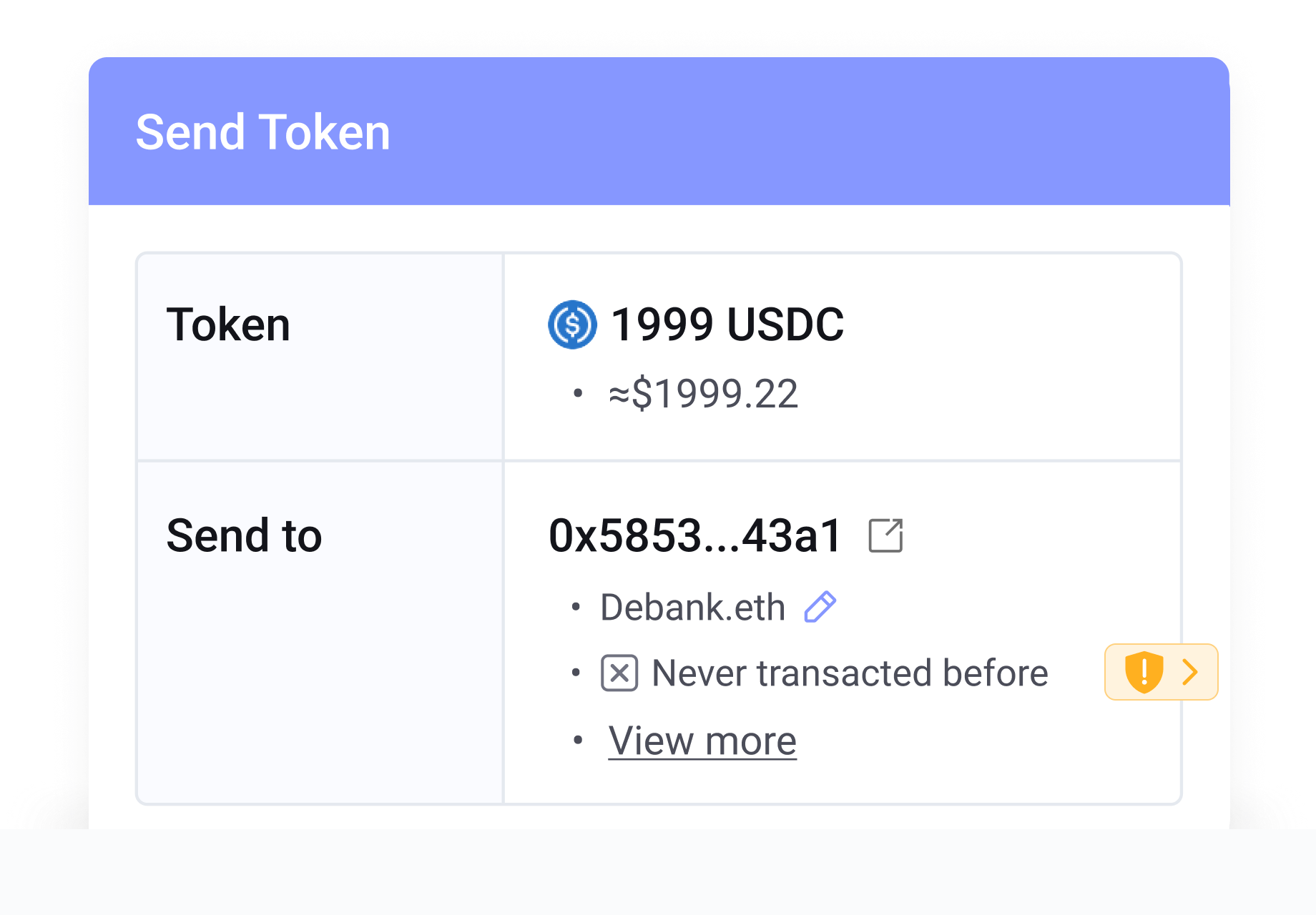
How Rabby’s transaction simulation works — mechanism, not marketing
Mechanism first: transaction simulation runs a dry‑run of the exact transaction against a node or local EVM-like environment and computes the state changes — token transfers, fee deduction, and contract calls — that would occur if the transaction were mined. Rabby surfaces those outputs to the user: estimated token balance movements and fee costs, plus a colored risk signal when the built-in security engine flags suspicious patterns (known hacked contracts, abnormal approval sizes, or non-existent recipient addresses).
Why that matters: blind signing — approving an arbitrary contract call without a concrete readout of its effects — is one of the most common ways users lose funds. A simulation turns a black-box ABI call into a readable delta: “You will send X tokens, receive Y tokens, pay Z in fees.” That simple mapping collapses many attack surfaces (malicious approvals, stealth drains, mistaken contract addresses) into information that a human can act on.
Where simulation reduces risk, and where it leaves gaps
Simulation stops many practical attacks but not all. It reliably shows local balance and state changes for EVM calls; it cannot retroactively protect against off-chain deception (phishing links that trick you into visiting a malicious dApp) or errors in the underlying smart contract semantics that are benign in simulation but exploitable under different assumptions. Moreover, simulations depend on accurate node state and gas estimation; race conditions, MEV reorgs, and on-chain oracle price shifts can alter the final outcome between simulation and mining.
Rabby mitigates some of those limits with layered checks: a pre-transaction risk scanner that flags known compromised contracts and odd approvals, hardware wallet integrations (Ledger, Trezor, Keystone, and others) that keep keys offline, and an approval revocation tool to reduce long-lived exposure. But it cannot eliminate market dynamics (slippage or oracle manipulation) or guarantee that a third-party smart contract is free of logical bugs.
Practical trade-offs for the DeFi power user
Choosing a wallet is always a trade-off between usability and control. Rabby sits toward the control-plus-usability quadrant for several reasons: automatic network switching removes a frequent source of error when interacting with cross-chain dApps; the Flip toggle makes it easy to switch between MetaMask and Rabby as default, lowering the friction of migration; and portfolio aggregation gives a single-pane view across 90+ EVM chains. The downside: Rabby does not embed a fiat on-ramp and lacks native in-wallet staking, which matters if you want a one-stop retail onboarding flow.
Compare alternatives briefly: MetaMask is ubiquitous and highly integrated with many dApps but lacks built-in simulation and pre-transaction scanning by default; Trust Wallet and Coinbase Wallet prioritize simple mobile onboarding and fiat rails, but they offer less visible pre-signing analysis. For institutional or multi-sig setups, Rabby’s integrations with Gnosis Safe, Fireblocks and custodial partners give it parity with enterprise needs, while the open-source MIT license invites external audits — a meaningful transparency signal.
One sharper mental model: the “simulation as a defensive lens” heuristic
Use this decision-useful framework: treat simulation as a lens that turns contract calls into observable deltas, then ask three rapid questions before signing: 1) Do the simulated outflows match the intended action? 2) Is any approval amount greater than necessary, and can I revoke or set a smaller allowance? 3) Does the risk scanner flag the contract or recipient? If any answer is a red flag, pause and research; revert to hardware signing for higher-risk transactions.
This heuristic is compact but powerful: it translates Rabby’s technical output into a repeatable human workflow. It also highlights where other controls are necessary — offline key storage for custody, separate session wallets for high-value activity, and gas top-ups for cross-chain operations where you might otherwise accidentally reject a transaction for lack of native gas.
Security posture in context — honest limits and historical lessons
History matters. Rabby’s 2022 swap contract exploit (~$190k loss) shows that even wallets and their affiliated services can be vectors if related contracts are insecure. The team’s response — freezing the contract, compensating users, and increasing audits — indicates operational maturity, but it is also a reminder: wallets reduce user error and certain classes of attacks but cannot make insecure smart contracts safe. Users should treat simulation as necessary but insufficient — part of a broader security hygiene that includes hardware wallets, minimal approvals, and cautious interaction with new dApps.
There are practical boundary conditions: simulations assume the current chain state and cannot predict future oracle movements or MEV-induced reordering; automatic network switching is convenient but could redirect you to a malicious copy of a dApp if you rely solely on URL appearance. Always verify contract addresses independently when moving large sums, and use hardware confirmations for critical approvals.
What to watch next (conditional signals, not predictions)
Watch for three signals that will change the wallet security landscape: improved standardized simulation APIs across nodes (which would shrink latency and increase fidelity), wider adoption of transaction intent manifests (machine-readable statements of user intent), and regulatory pressure that could push wallets toward built-in KYC or fiat solutions. Each signal comes with trade-offs: better simulation APIs lower false positives but could centralize trust; mandated fiat rails improve onboarding but introduce custody and privacy trade-offs.
For US-based power users, the regulatory conversation matters because it will shape whether wallets remain pure non-custodial UX layers or become hybrid gateways subject to compliance. The current facts support relying on non-custodial tools like Rabby while staying alert to policy shifts that could alter ecosystem incentives.
If you want to try Rabby yourself and evaluate the extension’s simulation experience against your routine strategies, a natural starting point is to download and test the extension in a low-risk environment, use hardware signing for high-value actions, and repeatedly exercise the approval revocation flow until it becomes second nature. For an official download route and product pages, see rabby.
FAQ
Does Rabby’s simulation prevent all smart contract exploits?
No. Simulation shows what the transaction would do to the current on-chain state, which prevents many blind-signing attacks and accidental drains, but it does not prove the contract’s internal logic is safe under adversarial conditions (oracle manipulation, reentrancy in complex flows, or front-running). Treat simulation as a strong defensive layer, not a formal verification step.
How reliable are the simulations across different networks?
Simulations are generally reliable for EVM-compatible chains because they replay transactions against the node state. However, reliability depends on node synchronization, gas estimation, and on-chain state freshness. High congestion, MEV activity, or stale RPC endpoints can produce differences between simulated and mined outcomes. Use diversified RPC endpoints and conservative slippage settings for high-value operations.
Can I use Rabby with a hardware wallet and still get simulations?
Yes. Rabby integrates with Ledger, Trezor, Keystone and others, combining the offline key security of hardware devices with Rabby’s simulation and pre-transaction scanning. The hardware device signs the final transaction; Rabby shows the simulated effects beforehand so you can confirm intent on both sides.
Is there a way to reverse approvals if I make a mistake?
Rabby includes a built-in approval revocation tool that lists active allowances and lets you reduce or cancel them. This reduces the window an attacker would have if a contract or key is compromised. Still, revocation is preventative; it cannot recover funds already moved to a malicious address.